Slate Truck Specifications At A Glance
| Spec / Metric | Official Value |
|---|---|
| Starting MSRP | $24,950 |
| Estimated Range | 205 miles |
| Battery Capacity & Type | 65 kWh LFP (Prismatic Cell-to-Pack) |
| Peak DC Fast Charging Speed | 120 kW (10–80% in ~30 minutes) |
| Onboard AC Charger | 11 kW (NACS Charging Port) |
| Turning Radius | 37 feet |
News Summary: Slate Drops Big Details and a $25k Price Tag
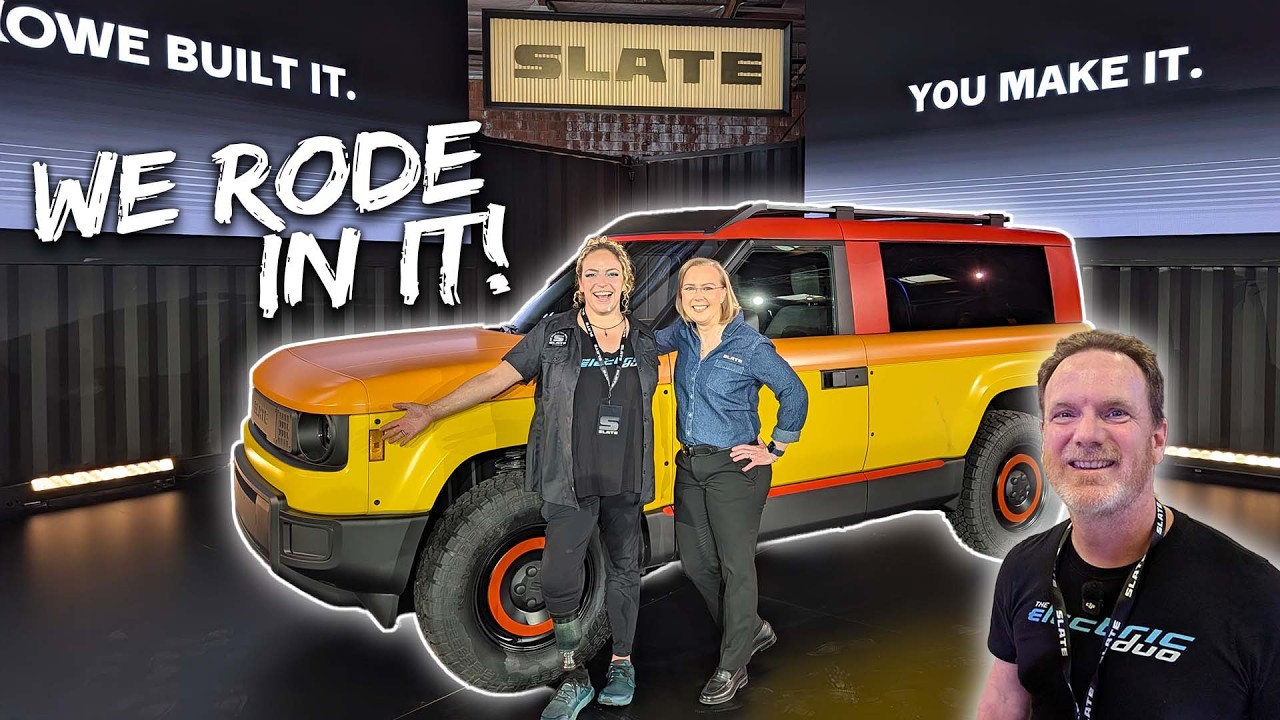
We got an exclusive look inside Slate's brand-new design studio, where the team dropped major announcements regarding their upcoming electric truck. Slate confirmed that the base vehicle starts at just $24,950. Originally, the company planned to offer two battery sizes starting at a 150-mile range. However, after listening to customer reservation feedback, Slate simplified the line to a single standard 65 kWh LFP (Lithium Iron Phosphate) pack providing 205 miles of range—at no additional cost.
During our visit, we also got into a validation prototype for our very first ride-along with Slate engineers. Customer deliveries are set to begin near the end of this year, with full-scale production taking place at their renovated 1.4 million square foot manufacturing facility in Warsaw, Indiana.
Industry Context: Reframing Affordable Electric Utility
In a market where the average new vehicle price lingers near $48,000 and standard EV pickups routinely clear $60,000, Slate is taking a radically different approach. By engineering a vehicle with roughly 800 parts—compared to 2,000 to 5,000 in a traditional truck—they have stripped out bloated manufacturing costs. There is no built-in infotainment screen cluttering the dash; instead, owners bring their own phone or tablet. Advanced driver-assist extras and luxury options are completely removed from the assembly line and shifted to an aftermarket ecosystem.
Adopting an LFP prismatic cell-to-pack architecture gives the vehicle long cycle life and thermal stability while keeping battery production cost low. This lean engineering model offers a real solution for budget-conscious buyers, fleet operators, and young drivers who want a modern EV without getting buried under a massive loan.
The Electric Duo Take: Hands-On Drive & Modular Innovations
Smooth Road Dynamics and Surprising Headroom
Stepping inside the "blank slate" base truck, the first thing we noticed was the incredible sense of open space. Even for tall drivers, headroom is huge. Because Slate opted out of a bulky center console in the base trim, legroom feels wide open. The manual crank windows and physical HVAC controls are a throwback to simple, durable trucks like the 1990s Ford Ranger, but the door slams shut with a solid, high-quality thud.
On the road, the driving dynamics surprised us. Paired up with Slate’s noise and vibration engineers, we took a validation vehicle over pothole-ridden parking lots and tight street corners. The suspension soaked up harsh impacts easily without transferring cabin noise. With a tight 37-foot turning radius and immediate EV torque, it feels nimble, planted, and remarkably easy to park.
Modular Architecture: From Truck to Fastback SUV
What makes Slate truly unique is its transformation capability. The entire vehicle uses a unified skeleton. By unbolting the rear glass partition, owners can install modular roll cages, side panels, and rear seating to turn the two-door pickup into a four-passenger SUV or a fastback design. The vehicle’s onboard sensor network automatically detects when safety components like side curtain airbags in the roll cage are plugged in, ensuring error-proof safety configurations.
Key highlights of this modular setup include:
- DIY Repairability: Body panels are made from durable glass-filled polypropylene composite. If a panel gets dinged or cracked, you can unbolt it, repair it with bondo, or replace it entirely in your driveway without insurance overhead.
- Right-to-Repair Tech: Owners access full diagnostic data directly through the mobile app, eliminating the need for proprietary OBD2 shop tools.
- Budget-Friendly Accessories: Slate targets under $500 for 80% of its official accessories, ranging from custom wheel covers and tail-light covers to interior trim swap kits and wrap packages.
Seeing Slate execute this level of hardware optimization in person proves that affordable, modular EVs aren't just a concept—they are right around the corner. We can't wait to get our hands on a production unit and take it out on our typical road-trip routes.