Ford just pulled back the curtain on the bidirectional charging tech coming to the upcoming Ford Fathom. As someone running an all-electric garage with our 2022 Mustang Mach-E GT Performance Edition and 2024 Chevrolet Equinox EV, the hardware architecture here immediately grabbed my attention. Ford isn't just bringing vehicle-to-home (V2H) backup down to an entry-level truck—they shifted where the electrical conversion happens to cut the cost of home installation.
| Vehicle / System | Base Vehicle Price | Bidirectional Output | Output Format | External Inverter Needed? | Grid-Connected Peak Shifting |
|---|---|---|---|---|---|
| Ford Fathom (UEV) | $28,350 ($29,990 w/ destination) | >10 kW | AC | No | Yes |
| Ford F-150 Lightning | ~$70,000 (Flash / Extended Range required) | 9.6 kW | DC to inverter | Yes | No (Outage only) |
| Tesla Cybertruck | ~$70,000+ | Up to 11.5 kW | AC | No | Requires Powerwall setup |
| GM Ultium Home (e.g., Equinox EV) | ~$35,000–$43,000+ | Up to 9.6 kW | DC to inverter | Yes | No (Outage only) |
Onboard AC Power: Why the E-Box Changes the Hardware Equation
The headline spec is simple: the Ford Fathom will push over 10 kW of AC power back into your house. That distinction between AC and DC output is the entire story here.
Most electric vehicles store high-voltage DC power in the battery pack. When traditional bidirectional setups pull energy out to power a home, they send high-voltage DC out of the charging port to a dedicated wall-mounted inverter. That inverter converts the current to split-phase 120V/240V AC so your home panel can use it. That external hardware is bulky, complex, and notoriously expensive to purchase and wire.

The Fathom bypasses that external box by handling the conversion inside the vehicle using Ford's integrated "E-Box." This unit traces back to Auto Motive Power (AMP), an energy management startup Ford acquired back in 2023. Liv and I toured Ford's EV Development Center and saw their team working on this hardware firsthand. The E-Box consolidates onboard charging, power distribution, and bidirectional AC/DC conversion into a single package. Because the truck pushes out clean AC power directly, you do not need a multi-thousand-dollar standalone inverter hanging on your garage wall.
Slashing Hardware Costs: The Power Station and Backup Panel
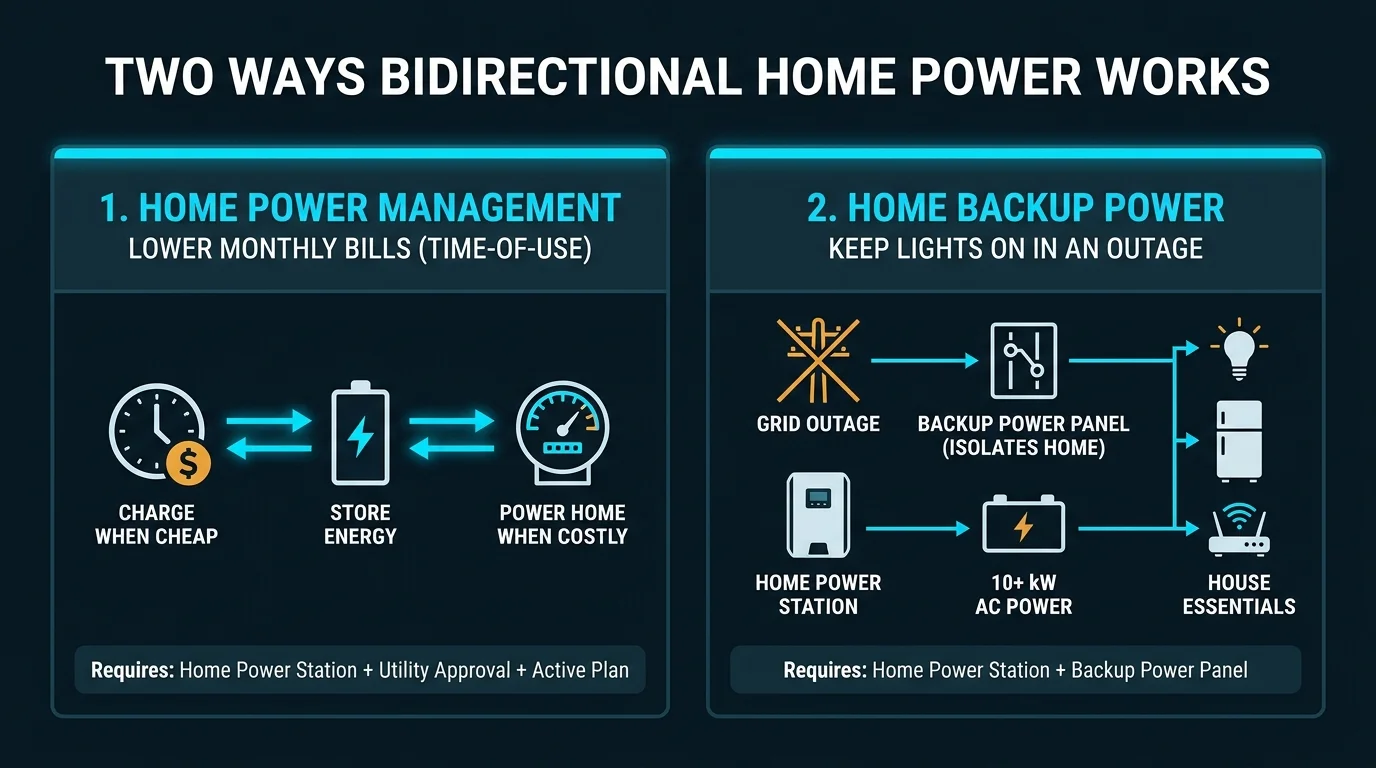
Eliminating that wall inverter translates directly into lower equipment pricing. Ford announced two primary home hardware components for the Fathom ecosystem, and both see steep price drops compared to first-generation hardware:
- Ford Home Power Station: Expected to cost roughly 50% less than the original 80-amp Ford Charge Station Pro.
- Ford Home Backup Panel: Expected to cost roughly 60% less than the first-generation Home Integration System used on the F-150 Lightning.
To put that in perspective, getting home backup out of an F-150 Lightning required stepping up to an Extended Range trim like the Flash or an optioned-up XLT—pushing the truck's sticker past $70,000. Add the Charge Station Pro, the transfer switch, and the heavy-duty inverter enclosure, and many owners were looking at thousands more before labor. The Fathom brings that baseline down to an entry-level trim starting at $28,350 (or $29,990 with delivery), offering higher output for less money.
Everyday Energy Shifting vs. Outage Backup
Ford is dividing the Fathom's V2H system into two distinct jobs: active home power management and emergency backup.

Outage backup is what most drivers picture. When the grid goes down, the Ford Home Backup Panel detects the drop, disconnects your house from the utility lines to protect utility workers down the road, and draws power from the truck to run designated circuits. With over 10 kW on tap, it will comfortably handle critical loads like refrigerators, lights, electronics, and even well pumps or central AC depending on startup surges.
The second mode—home power management—is where things get practical on a day-to-day basis. If you live somewhere with Time-of-Use (TOU) billing, you can schedule the Fathom to draw cheap electricity during super off-peak hours (like midnight to 6:00 a.m.) and discharge battery power back into your home during peak hours. Here in San Diego under SDG&E, our peak window runs from 4:00 p.m. to 9:00 p.m., when rates spike hard.
Running the house off the truck during those five hours could save an estimated $2 to $3 a day—around $60 to $90 a month off an electric bill. Over a few years, that daily energy shifting can pay off a decent chunk of the equipment installation.
There are two catches to note for grid-tied management:
- Utility Interconnection: Like rooftop solar, your electrician must submit an interconnection agreement to your local utility before you can push power into the home while connected to the grid.
- Software Subscriptions: Ford noted this feature requires an active Ford plan or trial. We do not know if that will carry a monthly fee after the trial ends, or what that cost looks like.
What We Still Don't Know—and What to Ask an Electrician
While the hardware direction looks solid, several critical technical specs remain under wraps. Ford has not published the Fathom's battery pack capacity, its estimated driving range, or its maximum DC fast-charging curve. Without the kilowatt-hour size of the battery, we cannot calculate exactly how many days of emergency backup the truck can supply during an extended blackout.
Another big question mark is your main electrical service. With earlier systems running high-amperage lines alongside separate inverters, homeowners frequently had to spend thousands upgrading from 100-amp or 150-amp panels to a 200-amp service. Because the Fathom outputs AC directly and relies on dynamic load management in the backup panel, there is a good chance many homes can avoid a full service upgrade. However, that is technical speculation on my part.
Before putting down money on any vehicle specifically for V2H, have a licensed electrician look at your current service panel, grounding setup, and available physical space. Every home layout is unique, and local permitting requirements vary widely.
Ford plans to reveal the production Fathom and open pre-orders in early 2027, with the first deliveries slated by the end of 2027. We will be tracking the hardware specs, trial plan details, and real-world costs as Ford makes them public.
Related